|
Eager Space | Videos by Alpha | Videos by Date | All Video Text | Support | Community | About |
|---|

LDEF framework crater analysis
https://sci-hub.se/https://www.sciencedirect.com/science/article/abs/pii/027311779390571R
Orbital debris database
https://orbitaldebris.jsc.nasa.gov/library/HOOSF_16e.pdf
Zerua orbitalal simulator
https://www.zerua.space/
Welcome to eager space...
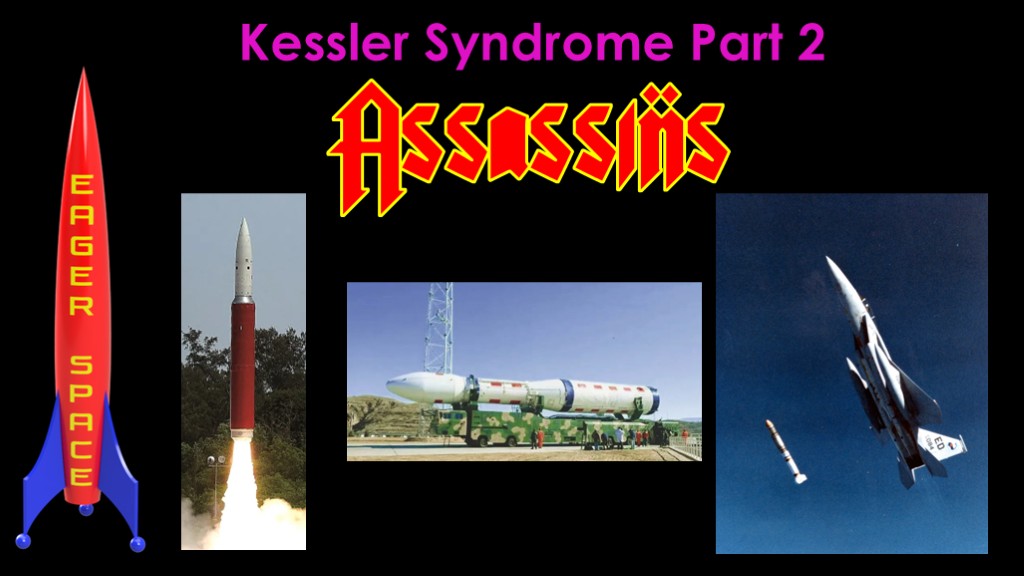
This is part 2 of our series on the Kessler syndrome, this time looking at anti-satellite weapons.
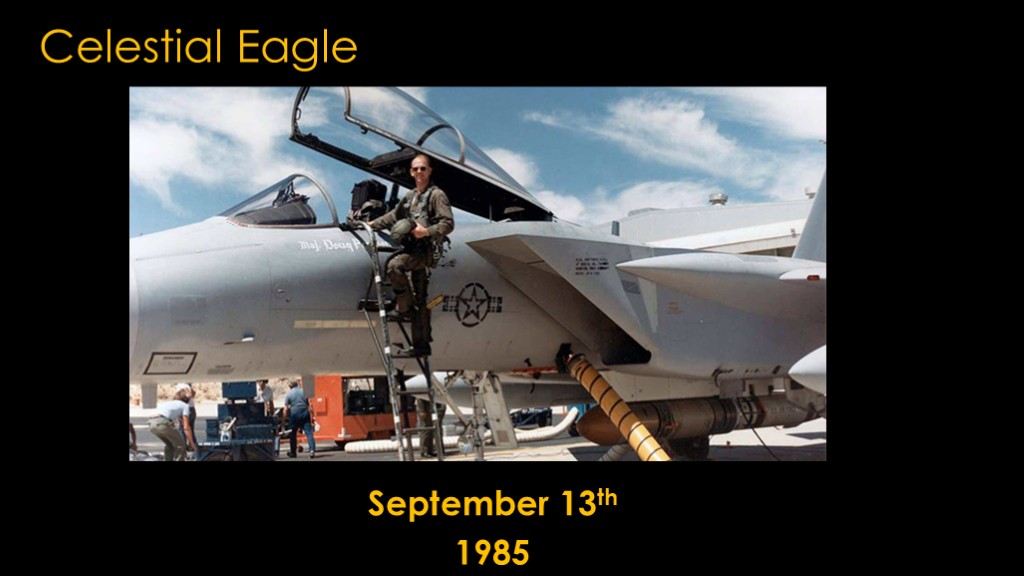
On September 13th in 1985, Major Wilbert Peterson climbed into a specially prepared F-15 Eagle fighter and took off.
His plane was carrying an 18 foot missile weighing a little more than a ton, a missile known as the ASM-135A, where the ASM means "Anti satellite missile".
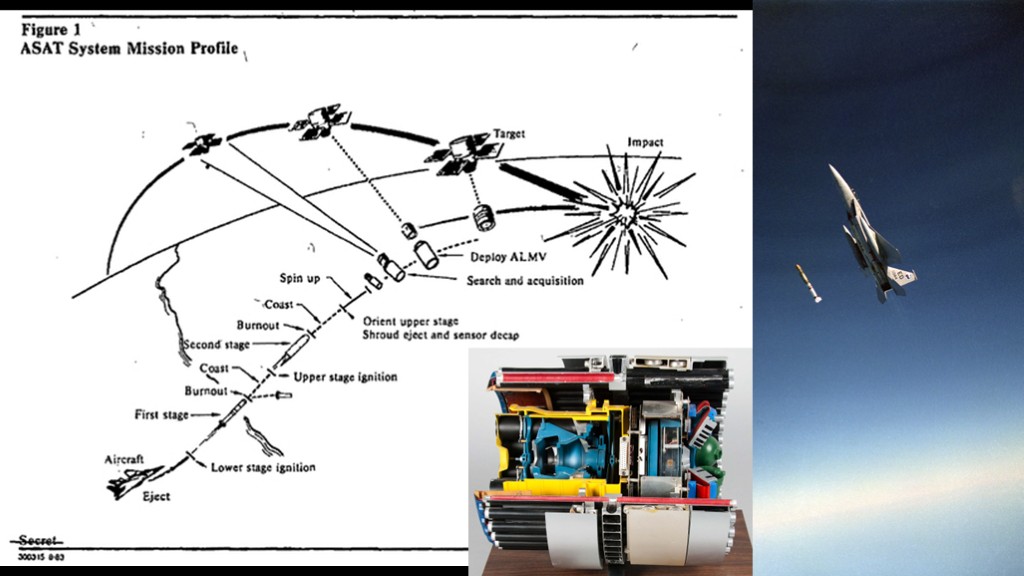
The F-15 carried the weapon to 38,000 feet in a 65 degree climb, and at that point the missile was released and began guiding towards the target.
The interception was performed by a miniature homing vehicle. There are no explosives in the vehicle and none are needed as the missile will be travelling at 4000 meters per second. As we saw with the collision of Iridum 33 and Cosmos 2251, kinetic energy is more than enough to destroy a satellite.
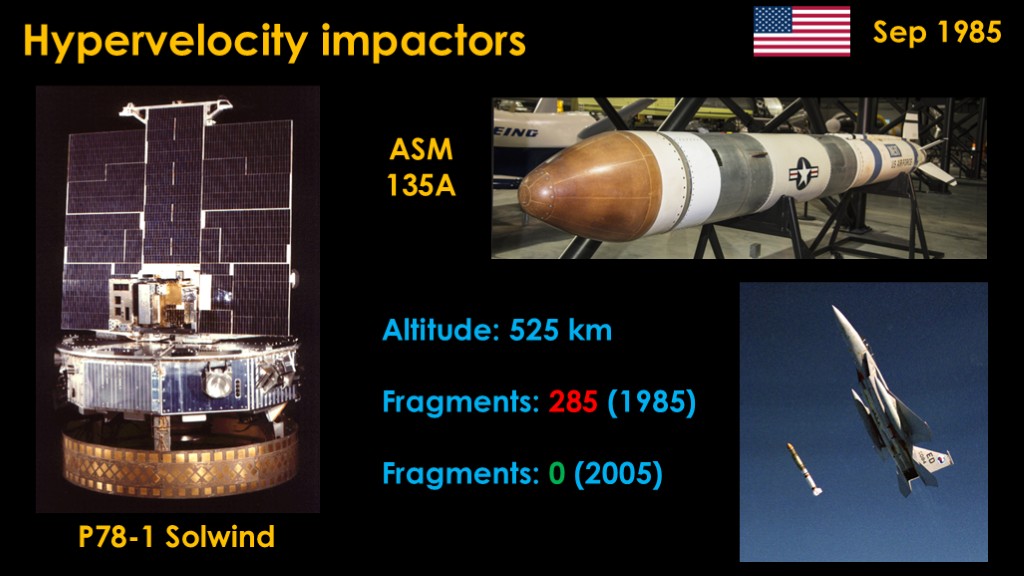
The target for this test was a solar observatory known as P78-1 solwind.
The impact was at 525 kilometers and created 285 tracked fragments. The last of those fragments reentered in 2005.
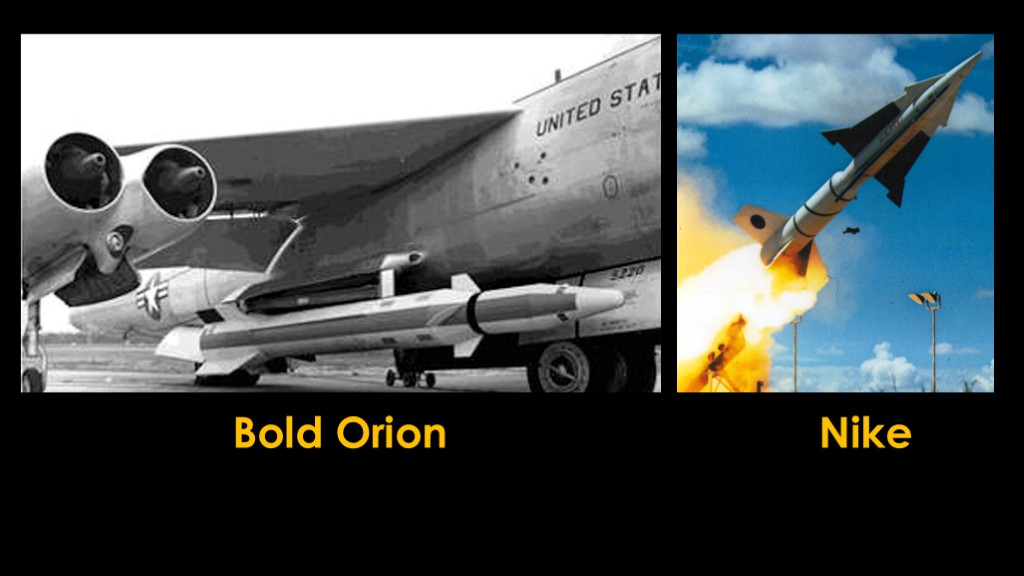
This ASM-135A test is often reported as the first test of an antisatellite weapon, but there was a system known as Bold Orion in the 1950s.
It was launched from a B-47 bomber in 1959 and successfully intercepted the explorer 6 satellite.
It didn't actually collide with the satellite, but since this was the 1950s, in actual use the missile would carry a small nuclear warhead, and it was believed that coming within 4 miles was close enough to destroy the target satellite. That was very likely true.
This was the same approach used by the Nike antiballistic missile interceptors that were deployed at sites across the united states. As I sit in the office of my house east of Seattle, there is one abandoned Nike site 4 miles north of me and another site 6 miles south of me.
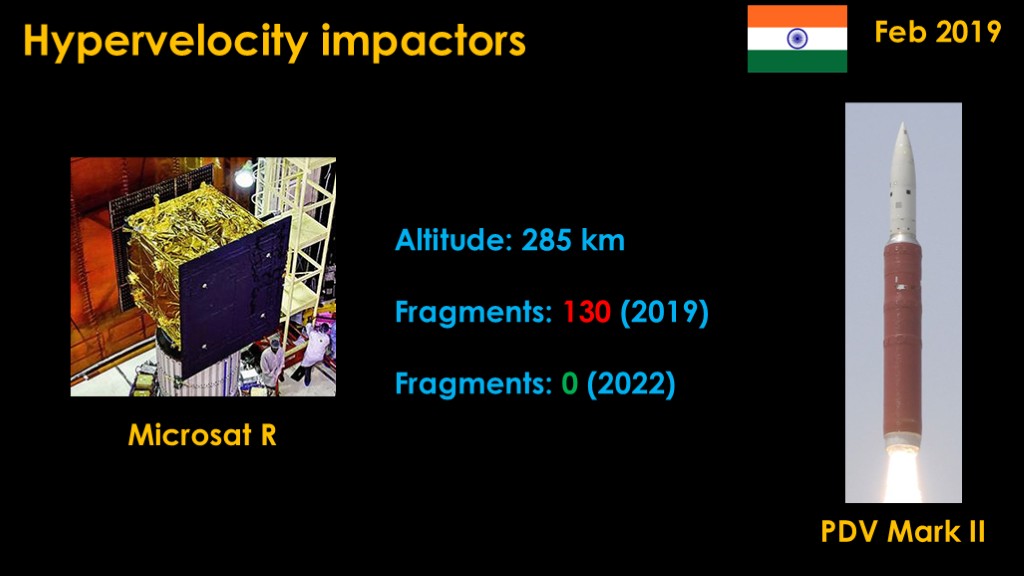
The US is not surprisingly not alone in building the antisatellite weapons known as hypervelocity impactors.
In January of 2019, India launched a small satellite named Microsat R.
In February of 2019, they conducted a launch of their PDV Mark II antisatellite weapon. It intercepted microsat R at an altitude of 285 kilometers and generated 130 fragments, the last of which decayed in 2022.
You may have noticed a pattern here - the tests that occur below 300 kilometers generate fragments that do not remain in orbit for very long.
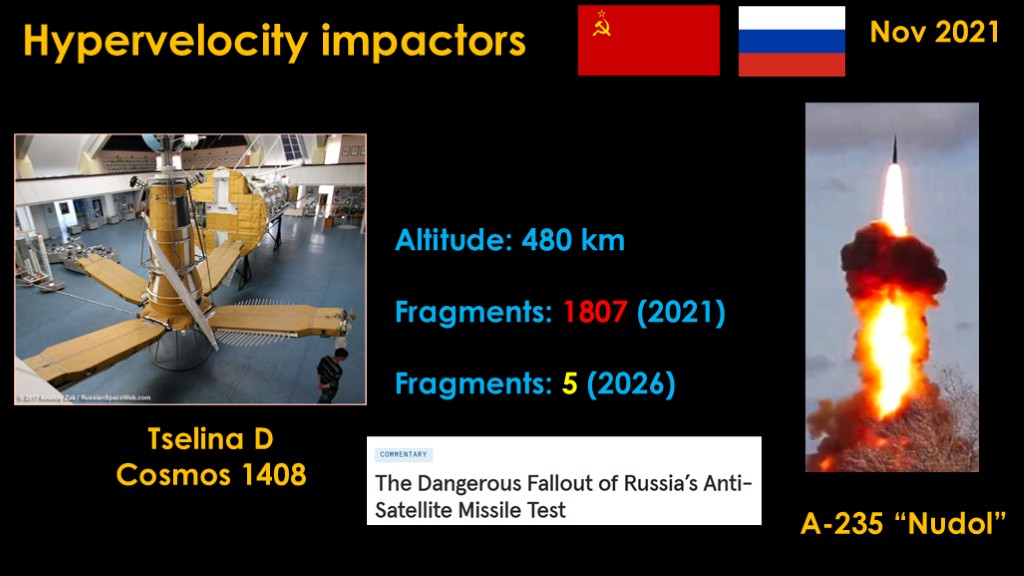
In 1982, the Soviet Union launched a Tselina D electronic intelligence spacecraft known as cosmos 1408. It operated for 2 years.
In November of 2021, Russia used cosmos 1408 as a target for their A-235 Nudol antisatellite weapon. The satellite was intercepted at 480 kilometers, and the collision resulted in a total of 1807 fragments.
This test generated a lot of pushback with the assertion that it would cause debris problems for many years and that it was "dangerous and irresponsible", and in fact it did lead to all the ISS astronauts sheltering in their capsules in case they needed to return to earth after an impact.
ASAT impactor tests always generate a lot of fragments and Russia looked foolish for putting their own cosmonauts in danger, but the debris field has dissipated quickly and as of 2026, there are only 5 tracked fragments remaining in orbit.
It really would have been nice if they didn't do the test, but it turned out not to be a long-term risk.
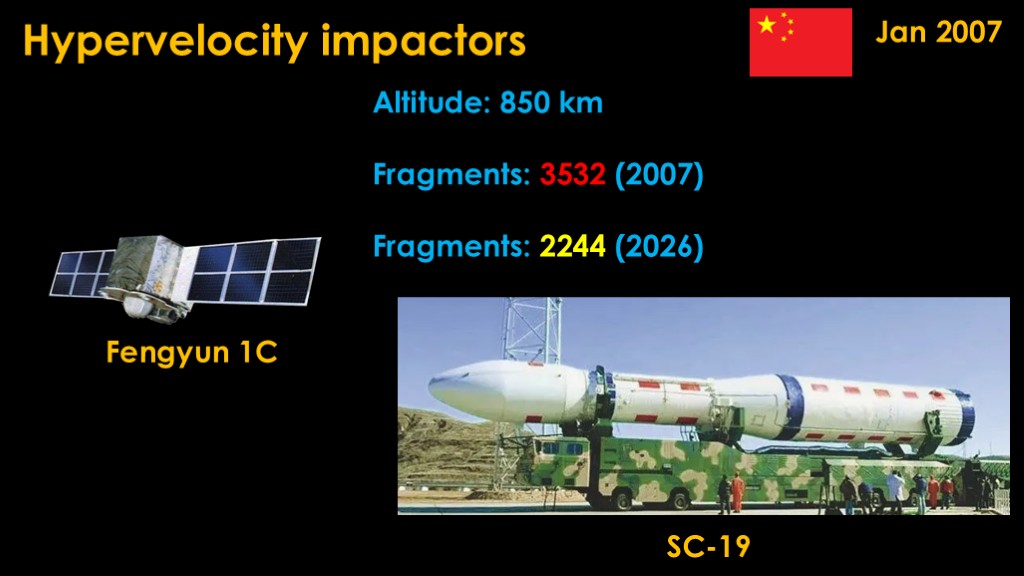
In May of 1999, China launched a weather satellite known as Fengyun 1C. It remained operational until 2005.
In January of 2007, China decided to test their SC-19 antisatellite missile on the Fengyun 1c satellite.
Because of the high orbit of the satellite - all the way up at 850 kilometers - this was an extremely antisocial act. It is *by far* the worst decision ever made related to orbital debris.
The impact generated 3532 tracked fragments, and you've likely guessed that the high orbit means most of them were long lived. You would be right - there are still 2244 fragments being tracked in 2026. Many of these fragments will remain in orbit for decades or centuries.
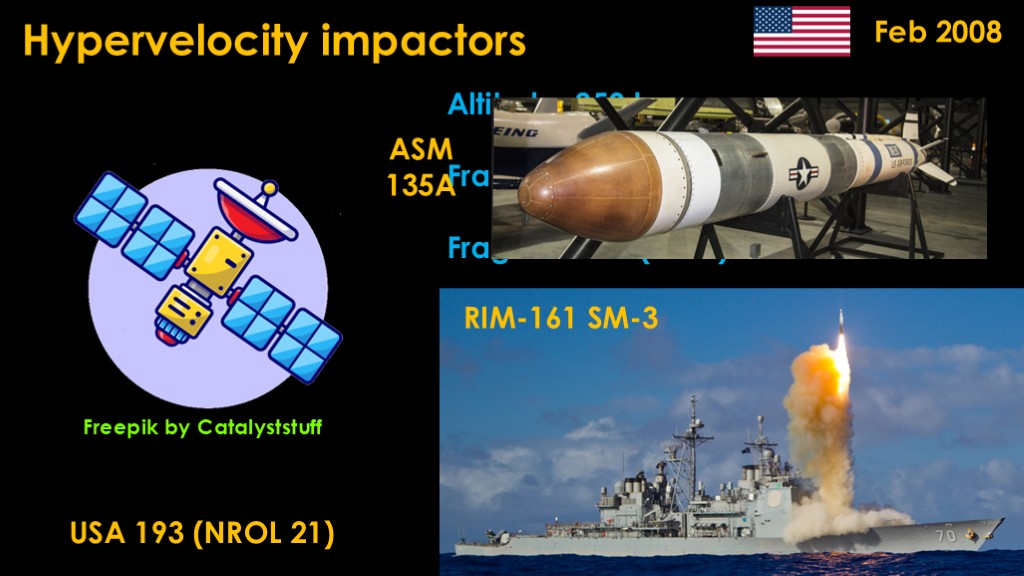
The US ASM-135A never actually made it into full deployment and the program was cancelled in 1988.
In December of 2006, the US launched a classified satellite only known as USA 193. It stopped working soon after launch. Reportedly, NASA's standard analysis tools indicated that the hydrazine fuel might survive reentry, and it was destroyed by a RIM-161 SM-3 missile launch from of a US Navy Cruiser, impacting with the satellite at 250 kilometers. generating 175 fragments.
The last of those fragments reentered by October of 2009.
But this is a little weird.
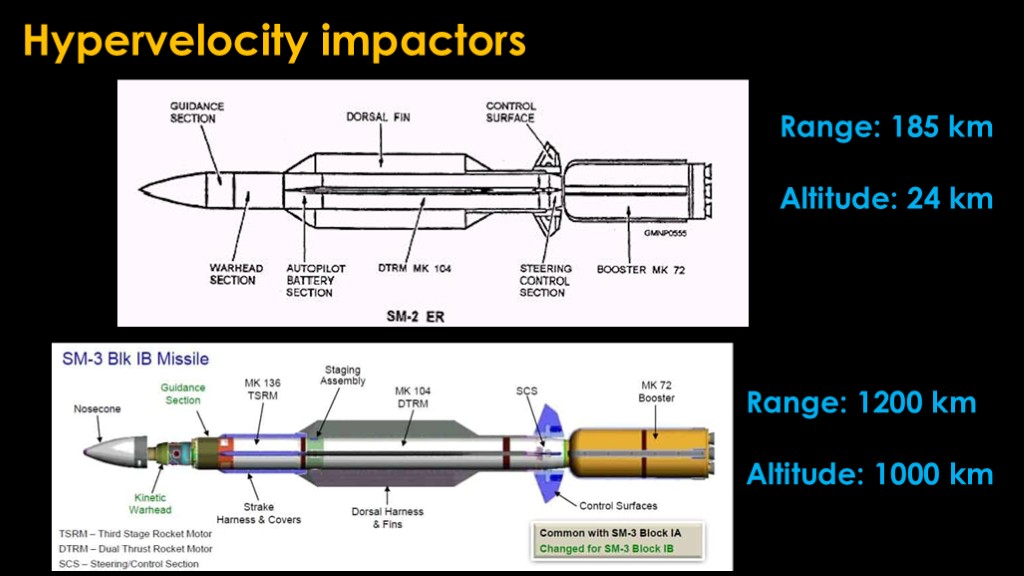
The SM-2 is the standard anti-aircraft missile used by the US Navy. The extended range version has a range of 185 kilometers and an altitude limit of 24 kilometers.
The SM-3 is essentially an SM-2 with the explosive warhead removed and a third stage added. It has a range of 1200 kilometers and can reach an altitude of 1000 kilometers. It was designed to intercept ballistic missiles.
If this can be done with a solid rocket, why aren't these used for space launches?
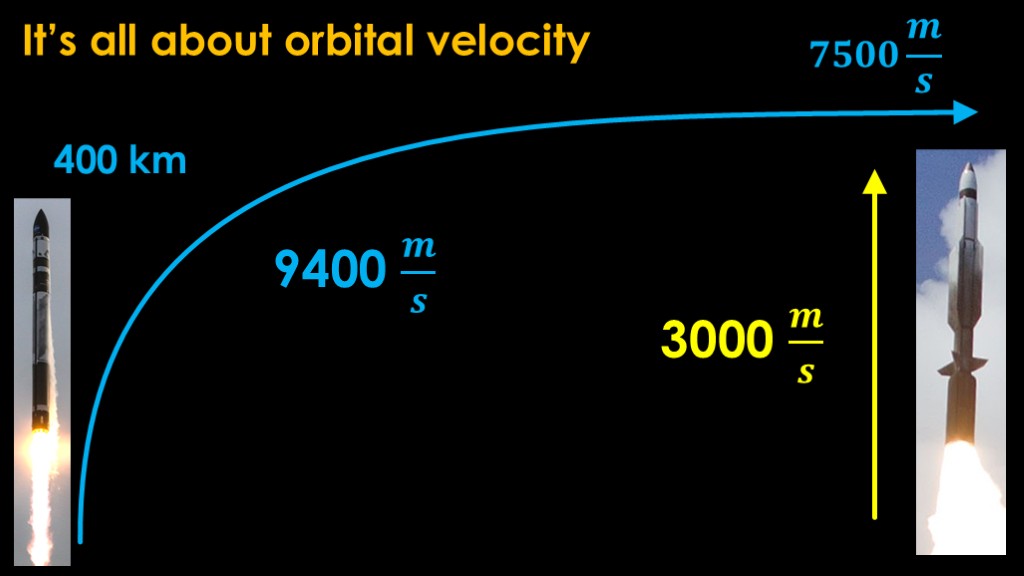
It's all about the orbital velocity.
If you want to launch a satellite into a 400 kilometer orbit, your vehicle needs to reach 400 kilometers in altitude and generate 7500 meters per second velocity to the side. That takes about 9400 meters per second of delta v. That is challenging and that is why liquid-fueled rockets are used.
An interceptor only needs to get to the altitude of the target satellite. That takes much less delta v, less than 3000 meters per second, and that is much easier to achieve with a launcher.
What this means is that antisatellite interceptors are relatively easy to build, and if you build an anti-ballistic missile system, you can very likely also use it as an antisatellite system.
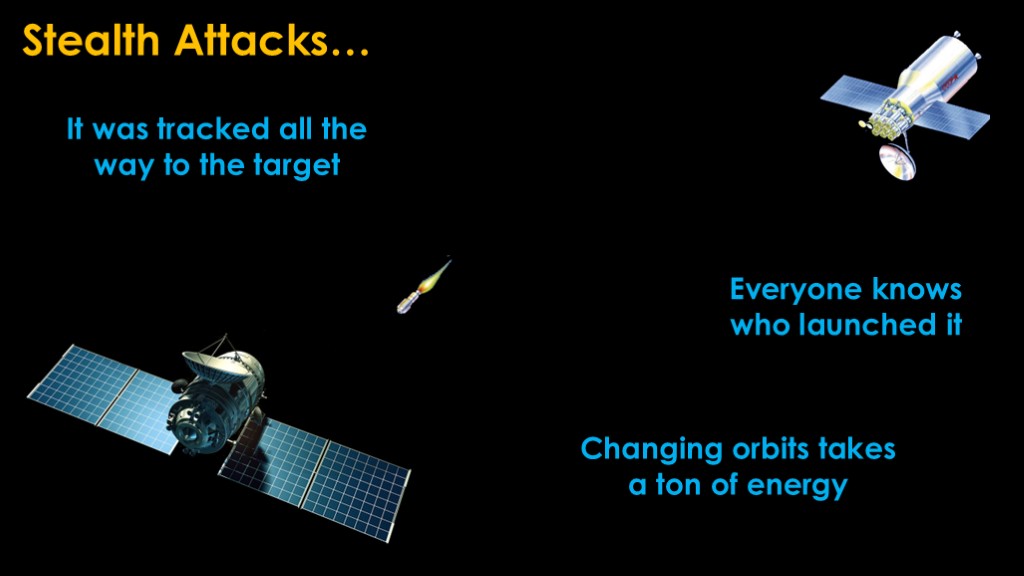
What about a sneak attack?
Let's say there's a spy satellite you want to destroy. You launch a killer satellite, which slowly sneaks up on the target. It then releases a small attack vehicle, which navigates to the target and destroys it. This is known as a "co orbital" approach, and has the potential to execute a nice stealthy attack.
Russian developed this approach in the 1960s and declared their system operational in 1973. They expanded in through the 1970s but it was cancelled in 1983, ironically after spurring the US to develop the ASM-135 missile program.
It turns out that it's not actually very stealthy.
Everybody knows who launched it because they know where the stealth satellite was launched from and it was tracked all the way to the target.
And changing orbits takes a ton of energy, so you may only be able to use this on a single satellite or maybe a few in the same orbital plane.
And, of course, you need to launch all the way to orbit to make this work. It's a more complicated and expensive approach than a ground or ship launched missile.
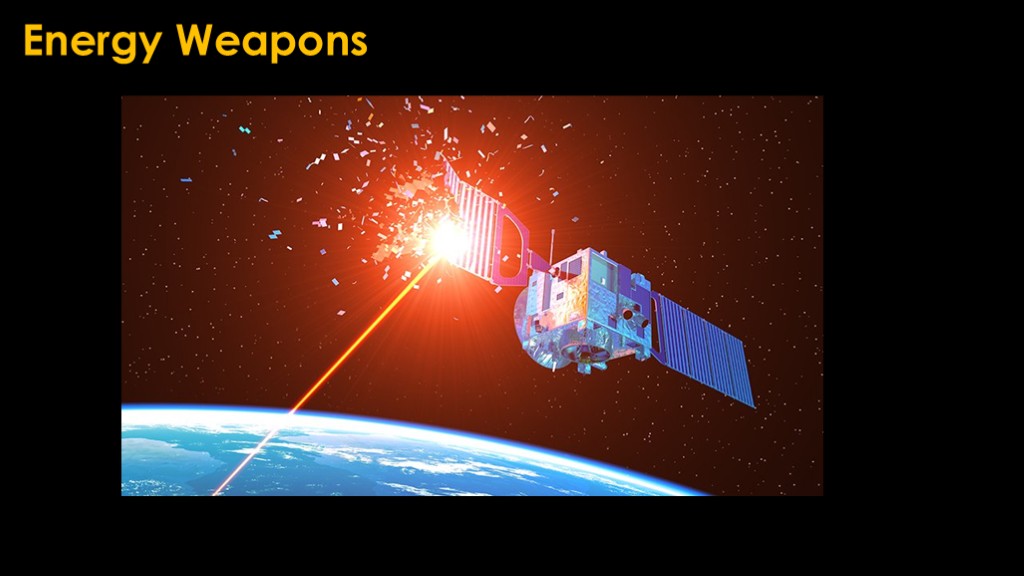
Another approach is to build an energy weapon capable of blinding or otherwise damaging satellites, using high energy lasers or microwaves.
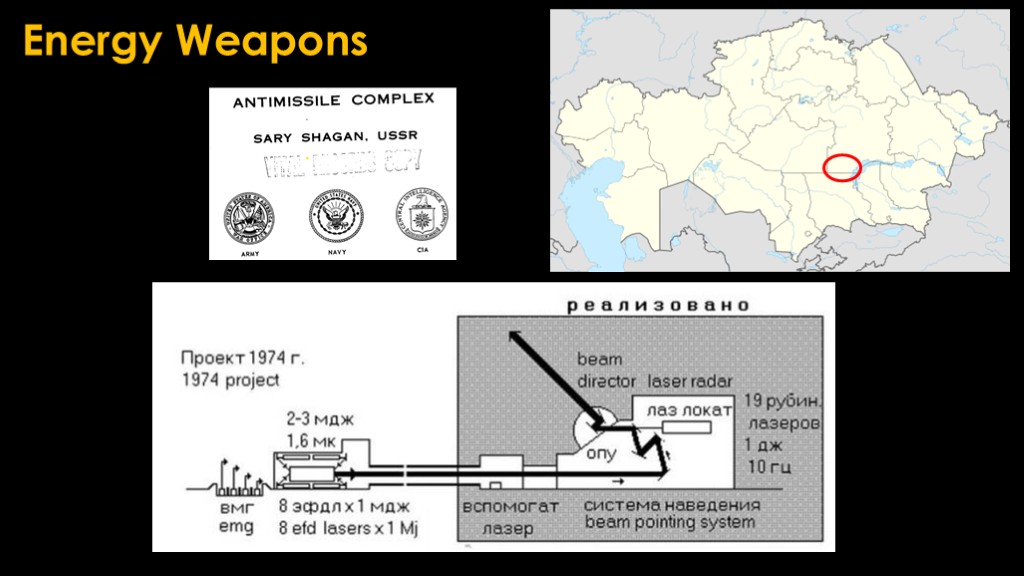
In the 1960s and early 1970s, the soviet union worked on anti-ballistic and anti-satellite laser weapons at a site known as Terra-3 in the Sary Shagan (sar-eh, with almost a roll on the r, Shah-GAHN) missile test site in Kazakhstan, but development was halted after the anti-ballistic missile treaty was signed in 1972.
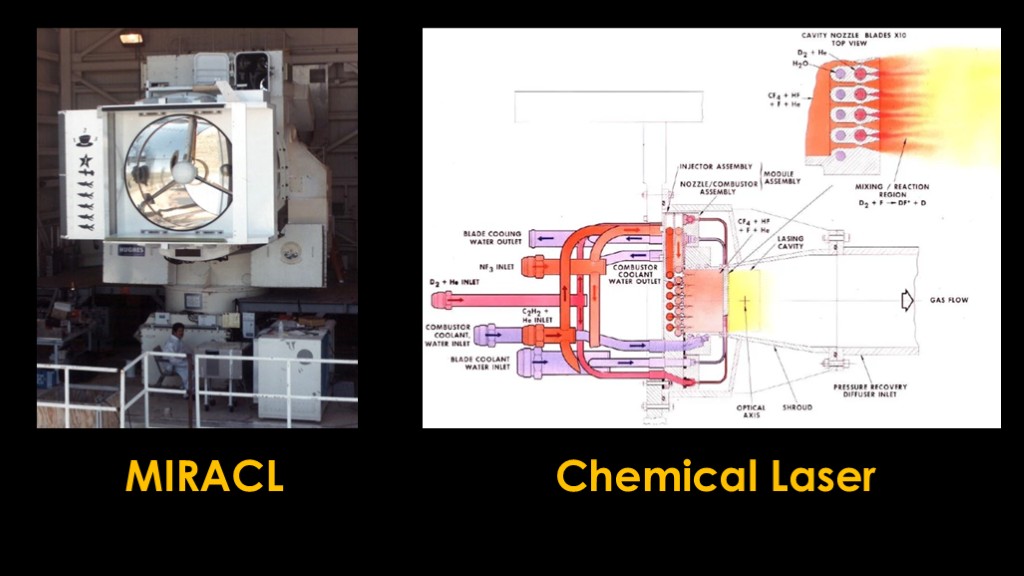
The US developed a ground based chemical laser known as MIRACL in the 1980s to track and destroy anti-ship cruise missiles, but it was also targeted towards anti-ballistic missile and anti-satellite roles.
A chemical laser is similar to a rocket engine. This one burned ethylene gas with nitrogen trifluoride to produce hot fluorine exhaust. Hydrogen was injected into the exhaust to produce very hot hydrogen fluoride, and that emitted the light that drives the laser.
In 1997 it was tested against an air force technology demonstration satellite that was going to reenter soon.
The test was labelled a success by the army but later information disclosed that the satellite was only targeted with a separate low-power system and the MIRACL firing was not a success and it was damaged in the process.
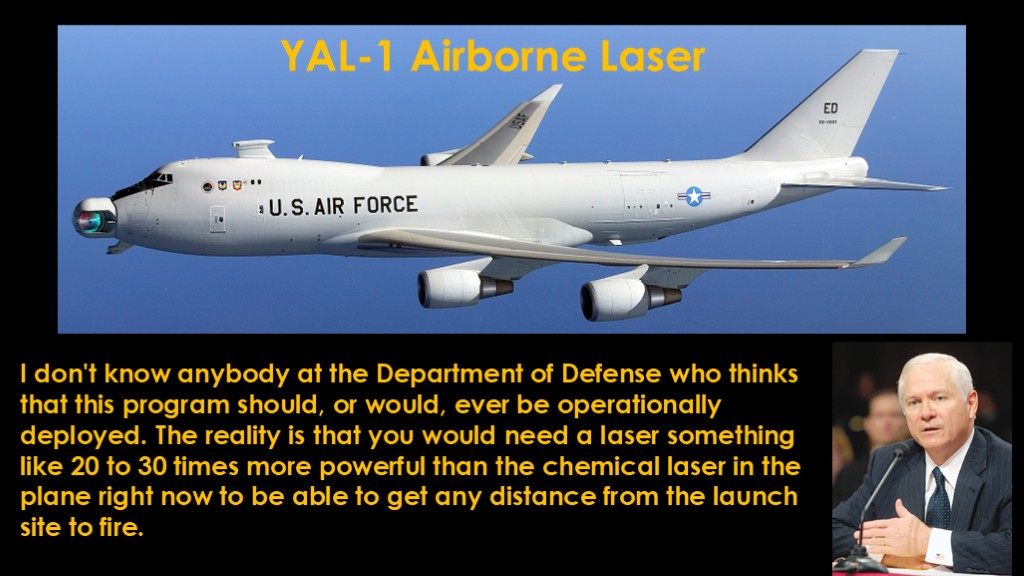
The US also developed the YAL-1 airborne laser for missile defense in the early 2000s, flying on a modified Boeing 747.
It used a chemical laser powered by hydrogen peroxide and chlorine, which produces hot oxygen atoms which are then used to excite iodine atoms which emit the light that drives the laser.
The program was cancelled in 2011. Secretary of Defense Robert gates said the following about the program:
(read)
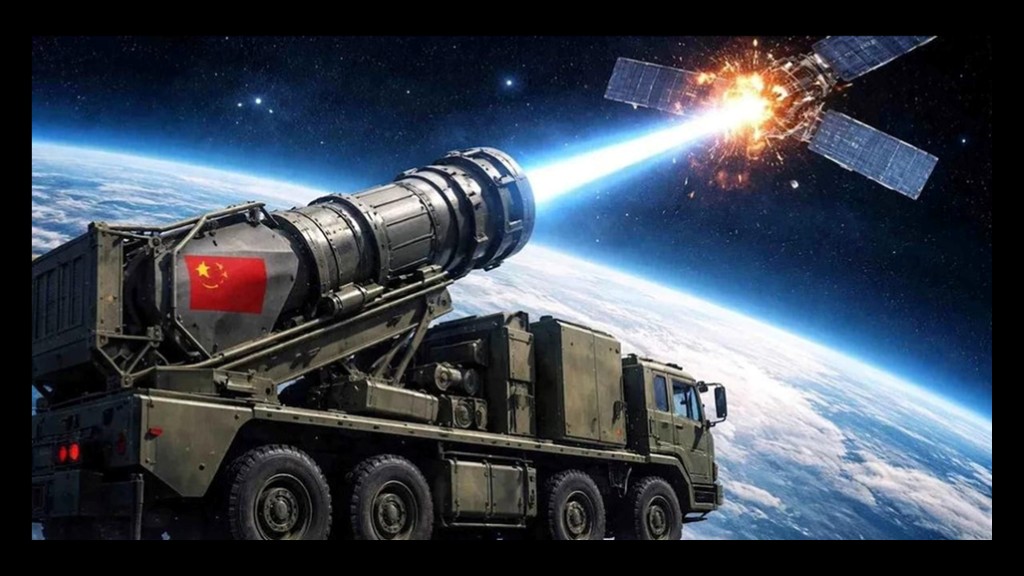
There are also reports of a Chinese microwave weapon that could disable satellites.
The energy weapons do have the advantage of generating less debris than the impactors, but it's not clear how well they will actually work in a real world scenario, and they are probably much more expensive than missile interceptors.
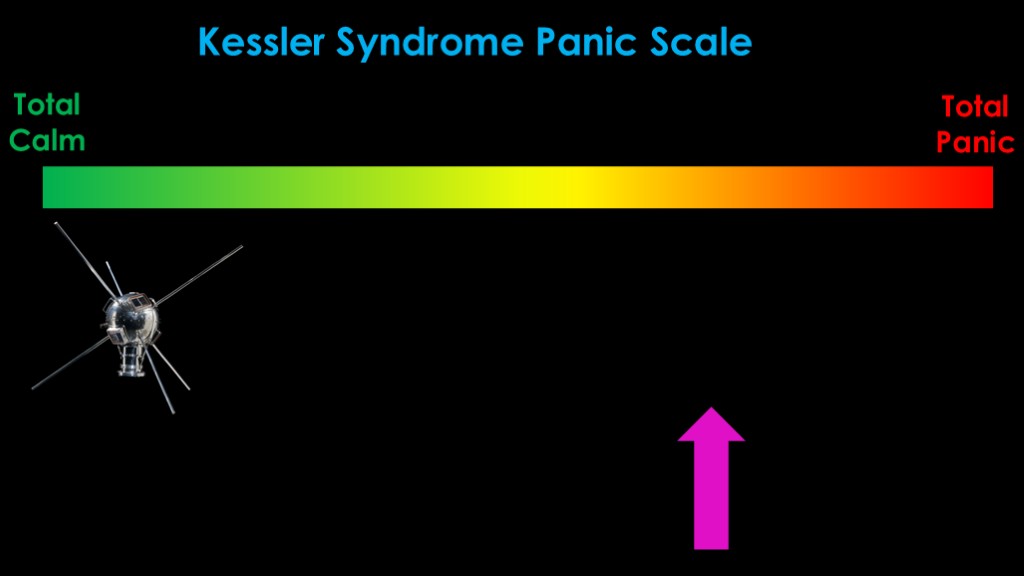
It's time to return to the Kessler syndrome panic scale, and here is where I ended up after the first video.
When I started on this video my belief was that hypersonic antisatellite weapons were the most likely cause of Kessler syndrome if they were used in military scenarios. And I still believe that they are unmatched in their ability to create a lot of debris in a very short time period and are therefore capable of overwhelming the current tracking system.
The hard part is to figure out how likely that is to happen. There would need to be a conflict in which countries wanted to use these weapons and also were in a position where they felt that other countries either wouldn't respond or that they had nothing to lose by using the weapons.
I don't have any way to estimate the odds on this, and I've therefore decided to keep the same estimate that I had previously.
And that's all for part 2. In part 3 we'll be looking at the derelicts in orbit.
Today's song is Strangers When We Meet off by the Smithereens off their 1987 album, Especially for You.
https://www.youtube.com/watch?v=U5wxubRFpVU